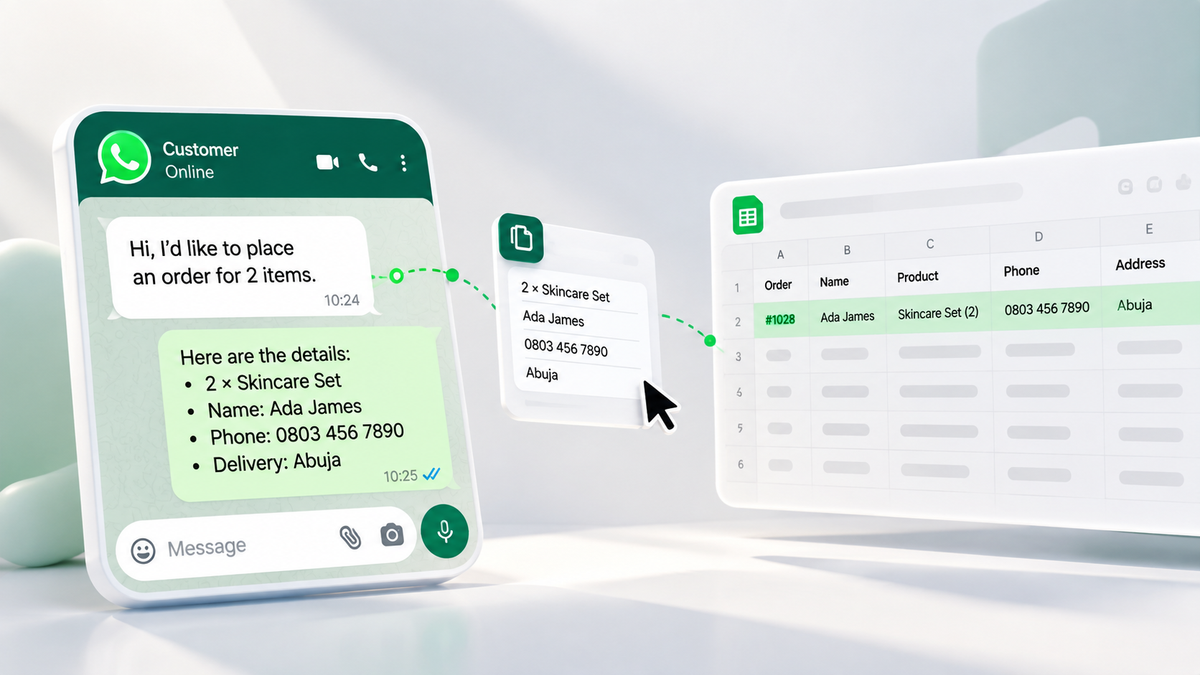
Your Team Is Still Copying Orders From WhatsApp Into a Spreadsheet. So What Exactly Is the AI Doing? Do I need AI to automate WhatsApp orders? Usually not first. Most WhatsApp order problems are data-entry or integration problems — AI is the last piece, not the first. What's the difference between automation and AI for business processes? Automation follows fixed rules to move or capture data. AI is needed when the task requires understanding language, judgment, or context — like knowing when to hand a conversation to a person. How do I know if my business needs custom software instead of off-the-shelf tools? When your current tool — a spreadsheet, a generic CRM — can no longer reliably do what the business now needs. Not before. A customer sees your product online and sends a message on WhatsApp. They want to buy. Someone on your team reads the message, asks for their details, and copies the order into a spreadsheet. Another person checks whether the product is available. The customer gets account details and makes a bank transfer. They send a screenshot. Someone confirms the payment, updates the spreadsheet, and forwards the order to whoever handles fulfilment. Later, the customer asks: "Has my order been shipped?" The person responding doesn't know. So they message someone in operations. Operations checks. The answer comes back. Then your employee returns to WhatsApp and replies to the customer. Nothing about this process is unusual. It may even be working. Orders are coming in. Customers are paying. Products are going out. But somewhere in the same business, there's probably now a conversation about AI. Should we add an AI customer service agent? Can AI handle WhatsApp? Can we automate sales? Can we build an AI assistant? Those are reasonable questions. But I'd ask something else first: What exactly is the technology supposed to fix? Because looking at this one order, "we need AI" isn't the obvious conclusion. There are several different problems hiding inside the process. And they don't all need the same solution. 01 Your employee is copying information that already exists The customer has already provided their name, phone number, product and delivery details. Then an employee manually enters that information somewhere else. That's repetitive work. You probably don't need AI for it. You need automation. If the information follows predictable rules, software can capture it, validate what's required and create the appropriate record automatically. The employee doesn't need an AI copilot to help them copy faster. They shouldn't be copying it at all. 02 Your systems know things your other systems don't Now the customer has paid. The payment system knows that. Your order system needs to know it too. Later, fulfilment knows the order has shipped. Customer support needs that information. If employees have to carry those updates manually from one system to another, that's an integration problem. Payment confirmed → update order. Order shipped → update status. Status changed → make the information available to whoever needs it. Sometimes the most valuable piece of software you build is something the customer never sees. It simply stops your employees from acting as the API between two systems. 03 You're automating a step that shouldn't exist Let's say every order needs approval from a manager. Nobody remembers exactly why. Three years ago, when the company was smaller, there may have been a good reason. Perhaps every large order genuinely needed someone to check stock, pricing or payment. But the company changed. The software changed. The team grew. The approval stayed. Now imagine someone proposes automating it. A developer builds a workflow. Every order is automatically routed to the manager. The manager gets a notification. They click approve. The workflow continues. Technically, the automation works perfectly. But nobody asked the more important question: Why does an ordinary order still need this approval at all? Maybe only unusual orders need review. Maybe orders above a certain value need approval. Maybe the checks that once required a manager can now happen automatically. The best solution might not be automating the approval. It might be removing it. That's a process problem. And it's why automating a workflow before understanding it can be expensive. You can build excellent software that makes unnecessary work happen faster. 04 The spreadsheet that started this story has reached its limit That spreadsheet may have been exactly the right tool when the company processed ten orders a week. Now imagine it's handling hundreds. The problem isn't that spreadsheets are bad. The operation has simply outgrown what this particular setup was designed to manage reliably. At that point, the question isn't: "How do we add AI to the spreadsheet?" It's: "What does the business need its order system to do now that this spreadsheet can't reliably do anymore?" Maybe an existing product solves it. Maybe you need a lightweight internal tool. Maybe the operation is specific enough to justify custom software. That's a software problem. 05 AI finally has a real job Return to the customer: "Has my order been shipped?" This time, everything underneath that question has changed. The order was captured automatically. The payment is connected to it. Fulfilment updates the order when it ships. The customer record, order status and delivery information exist in systems that can communicate. Now give the AI access to the appropriate information. The customer asks: "Has my order been shipped?" The AI doesn't generate a polite guess. It finds the customer's actual order. It sees that payment was confirmed Tuesday. It sees that fulfilment dispatched the package Wednesday. It retrieves the tracking information. And it answers. Then the customer says: "I entered the wrong delivery address. Can you change it?" That's different. The package has already been dispatched. Instead of inventing an answer or taking an action it shouldn't, the system recognizes the exception and hands the conversation to the appropriate person. But the employee doesn't receive: "Customer needs help." They receive the order, delivery status, conversation and reason for escalation. They can act immediately. Now the AI is doing something useful. Not because the model suddenly became smarter. Because the business finally gave it a system worth operating inside. That's the difference between putting an AI chatbot on top of a business and actually integrating AI into how the business works. Start with the work, not the technology The mistake is deciding you need AI and then searching the business for somewhere to put it. Start with the work. Find the friction. Understand why it exists. Then choose the simplest technology capable of fixing it. At GITS, this is the diagnostic we run before recommending any build — automation, integration, process change, better software, or AI, in that order. If employees are copying information that should move automatically, that may be automation. If they're carrying information between systems, that may be integration. If they're repeatedly performing a step nobody needs anymore, that's a process problem. If they're forcing a tool to handle an operation it has outgrown, that may require better software. And if the underlying systems are working but the job requires understanding language, retrieving context, making a bounded decision or knowing when to involve a person, that's where AI starts getting interesting. Sometimes the answer is AI. Sometimes it's an API call. Sometimes it's an automated workflow. Sometimes it's better software. And sometimes the smartest technical decision is to delete a step and build nothing at all. Tomorrow, ask your team one question: "What did you do yesterday that you've already done dozens of times before?" The answers might tell you more about where technology belongs in your business than another AI strategy meeting.
Your Team Is Still Copying Orders From WhatsApp Into a Spreadsheet. So What Exactly Is the AI Doing?
A customer orders on WhatsApp. An employee copies it into a spreadsheet. Payment gets confirmed by screenshot. Before asking whether you need AI, GITS breaks this down into five separate problems — automation, integration, process, software, and only then AI — each needing a different fix. Key Highlights Repetitive data entry is usually an automation problem, not an AI problem Systems that can't talk to each other need integration, not intelligence Automating a broken process just makes unnecessary work happen faster Spreadsheets don't fail — businesses outgrow what they were built to handle AI becomes genuinely useful only once it's operating inside a system that already works FAQ / Quick Answers (if your CMS has a dedicated FAQ field — separate from Article Content, since this is what powers the FAQPage schema) Do I need AI to automate WhatsApp orders? Usually not first. Most WhatsApp order problems are data-entry or integration problems — AI is the last piece, not the first. What's the difference between automation and AI for business processes? Automation follows fixed rules to move or capture data. AI is needed when the task requires understanding language, judgment, or context — like knowing when to hand a conversation to a person. How do I know if my business needs custom software instead of off-the-shelf tools? When your current tool — a spreadsheet, a generic CRM — can no longer reliably do what the business now needs. Not before. If your CMS doesn't have a separate FAQ field, put these three as the first block inside Article Content, before the WhatsApp story begins — that's where I placed them in the HTML version, since AI answer engines pull from whatever's earliest and most directly phrased as Q&A. Article Content Same body as before, with one addition: in the "Start with the work, not the technology" section, right after "Then choose the simplest technology capable of fixing it," add this line — "At GITS, this is the diagnostic we run before recommending any build — automation, integration, process change, better software, or AI, in that order." That's the one sentence that gives an AI answer something explicit to attribute to GITS by name, rather than citing "a source" anonymously.